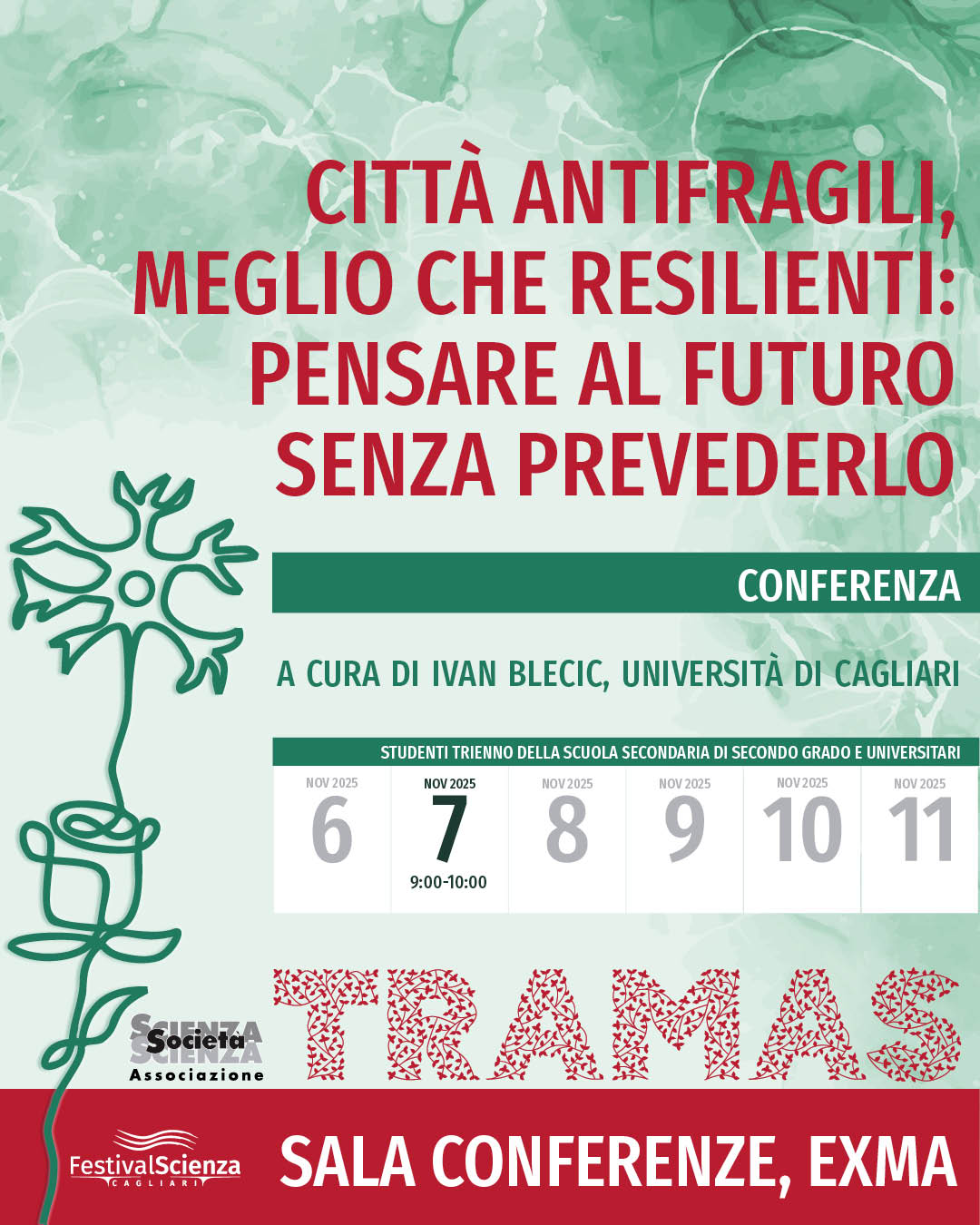
Antifragile cities, better than resilient: thinking about the future without predicting it
Antifragile cities, better than resilient: thinking about the future without predicting it
Conferenza
Scuola secondaria di II grado, Universitari
EXMA
By: By Ivan Blecic, University of Cagliari - DICAAR
Something is antifragile, the opposite of fragile, when it can benefit from the unexpected, from disruptions, from stressors, and from volatility, and can gain from them, become stronger, improve, evolve, and adapt better. Therefore, antifragility goes beyond resilience because resilient systems are simply resistant to disruptions, capable of recovering, bouncing back, and then returning to their former selves.
The concept of antifragility introduced by Nassim Taleb, reinterpreted from an urban planning perspective, challenges the idea of total control and predictability in planning, instead valuing the intrinsic unpredictability of complex systems as a generative resource. Antifragile cities draw strength from diversity, redundancy, and the capacity for collective learning to address environmental, social, and economic crises.
Antifragile cities can be designed through public policies, starting from the principle of primum non nocere, and pursuing modular design, decentralization through layering, redundancies, renouncing the impulse to suppress “chance,” and honoring the principles of “skin-in-play” and the “Chesterton enclosure.”
Ivan Blecic
Ivan Blecic is a full professor of Valuation and director of the DICAAR (Department of Appraisal and Planning) at the University of Cagliari. His research focuses on planning theory, urban simulation, and evaluation and decision-support methods and models for urban planning and land-use policies.
Field: Urban planning
Duration: 1 hour
Target: Scuola secondaria di II grado, Universitari