Scuola primaria, Scuola secondaria di I grado, Scuola secondaria di II grado, Universitari, Pubblico generico
EXMA
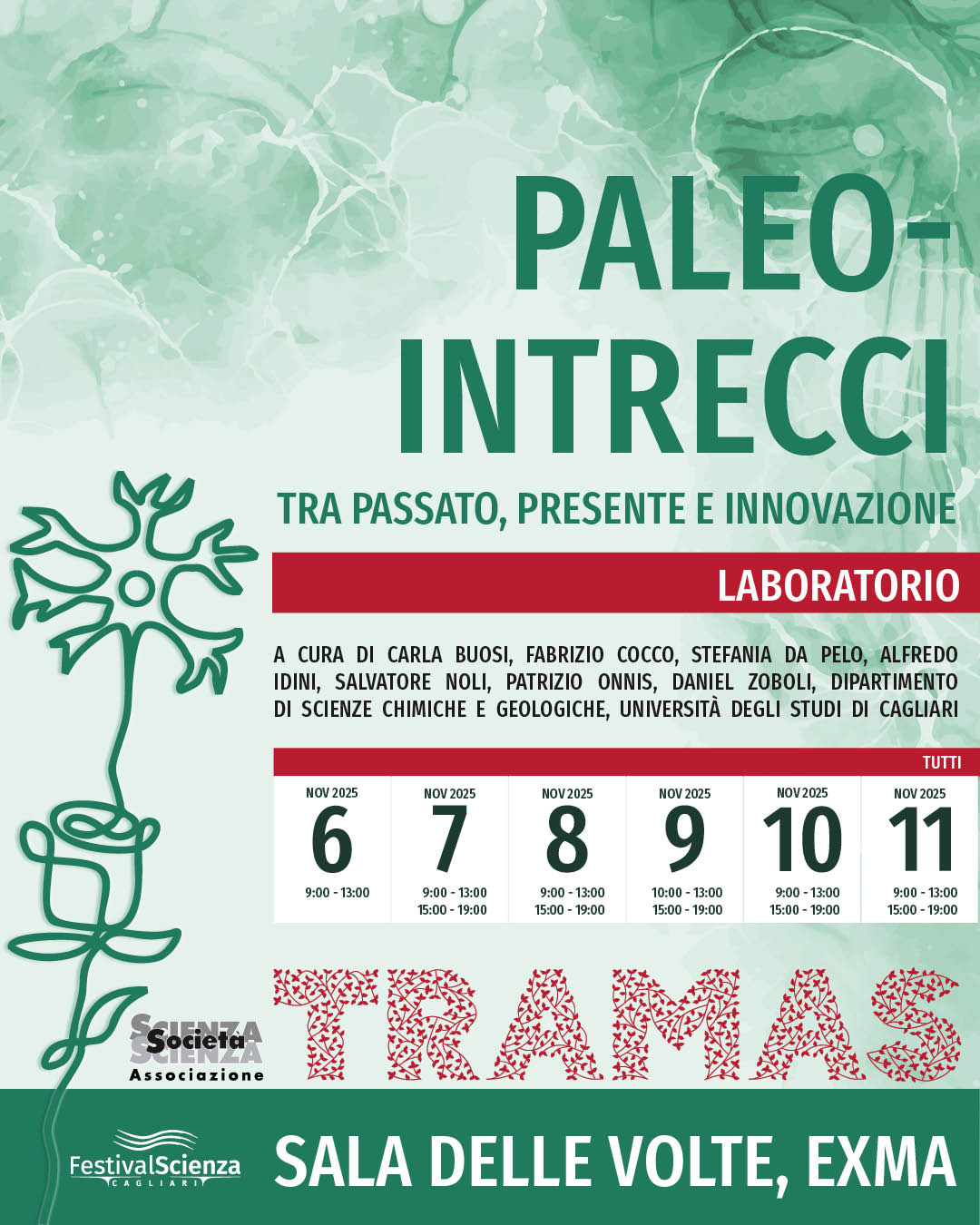
By: Carla Buosi, Fabrizio Cocco, Stefania Da Pelo, Alfredo Idini, Salvatore Noli, Patrizio Onnis, Daniel Zoboli (Department of Chemical and Geological Sciences, University of Cagliari)
Paleontology isn’t simply a look back into the past; it’s a discipline that intertwines seemingly distant worlds, creating a web of fascinating connections between geology, biology, climate, art, and technology. Fossils, silent witnesses of ancient times, tell the story of the evolution of life on Earth, showing how organisms have adapted and transformed in the face of often drastic environmental changes.
These remains, ranging from tiny microorganisms to gigantic dinosaurs, are more than just traces of the past. They reveal valuable lessons for our present and future. Through the study of fossils, scientists can analyze how past climate changes have affected ecosystems and species, offering crucial clues for addressing today’s climate challenges. At the same time, humans have transformed the interpretation of fossils into art, making them a source of inspiration for works ranging from literature to design.
Paleontology isn’t limited to academia: it permeates our everyday lives through advanced technologies like 3D scanning and additive manufacturing, which allow us to study and reproduce fossils in unprecedented detail. Furthermore, it educates and inspires new generations, highlighting how every piece of our natural history is crucial to understanding not only where we came from, but also where we might be headed.
Field: Geology
Duration: 30 minutes
Target: Scuola primaria, Scuola secondaria di I grado, Scuola secondaria di II grado, Universitari, Pubblico generico