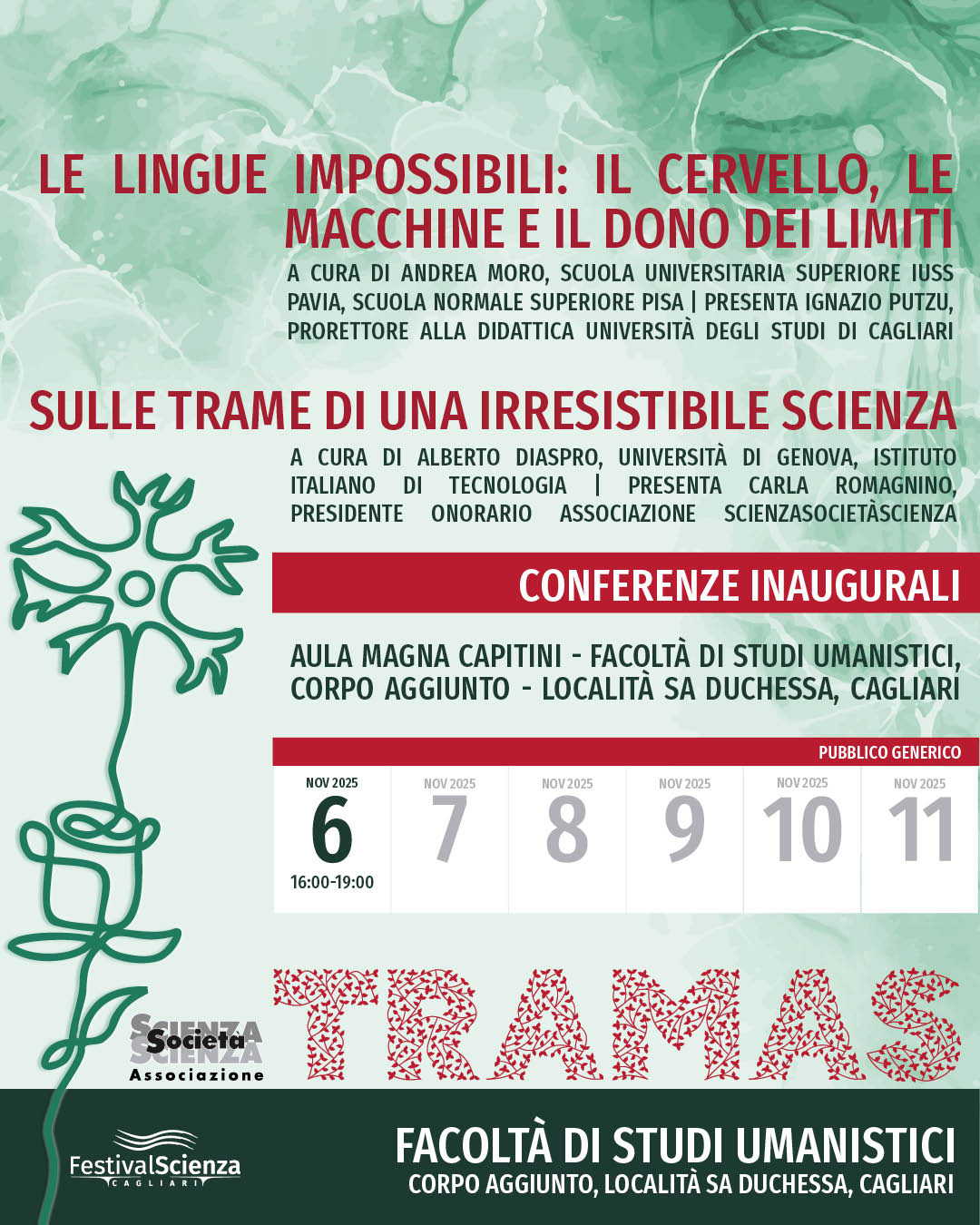
By: Andrea Moro (Accademia dei Lincei - IUSS Pavia University School of Advanced Studies - Scuola Normale Superiore Pisa) and Alberto Diaspro (University of Genoa - Italian Institute of Technology)
Presented by: Ignazio Putzu and Carla Romagnino
Impossible Languages: The Brain, The Machines, and the Gift of Limits
By Andrea Moro, Accademia dei Lincei – IUSS Pavia University School of Advanced Studies – Scuola Normale Superiore Pisa
Introducing Ignazio Putzu, Vice-Rector for Teaching at the University of Cagliari
All living beings communicate, but humans are the only ones capable of generating ever-new meanings (sentences) by recombining the same elements (words). Despite apparent differences in the complexity of linguistic structures, this ability, called “syntax,” is expressed by the same simple operations that are invariant in all the world’s languages. What explains the existence of the “boundaries of Babel”? Contemporary neuroscience has provided the answer, based on measuring the human brain’s reaction to “impossible” languages—languages not contained within the boundaries of Babel. The impact of this discovery has implications for numerous fields, including artificial intelligence: it overturns the traditional view that machines are too weak to simulate a human brain; on the contrary, they prove too powerful since impossible languages do not exist for them. Ultimately, this research leads to the conclusion that, at least as far as the human mind is concerned, we are our own limits.
On the plots of an irresistible science
By Alberto Diaspro, University of Genoa – Italian Institute of Technology
Presented by Carla Romagnino, Honorary President of the ScienzaSocietàScienza Association
“Tramas e filu” (Tracks and Threads) will guide us along a narrative thread that intertwines method with knowledge, beauty with the discovery of an irresistible science. The transition from written to figurative signs, inspired by Galileo, is the framework upon which the interweaving of physics, biology, astronomy, chemistry, and art unfolds. Thus, science is irresistible in sparking the innate curiosity of humankind.
Andrea Moro
Andrea Carlo Moro is an Italian linguist, neuroscientist, and writer. He is a full professor of general linguistics at the IUSS University School of Advanced Studies in Pavia, where he served as deputy rector for two terms (2012-2025), and at the Scuola Normale Superiore in Pisa. He is a member of the Accademia dei Lincei and, in 2025, was awarded the title of Commander of the Order of Merit of the Italian Republic. At the Vita-Salute San Raffaele University in Milan, he was among the founders of the Department of Cognitive Sciences (1993) and coordinated the degree program in Cognitive Neuroscience until 2010.
His research demonstrates that the syntactic structure of human languages is rooted in the neurobiology of the brain and not in cultural or social conventions. His method is based on neuroimaging techniques, such as functional magnetic resonance imaging. Moro is also developing research on the connection between brain and language, using novel methods, in collaboration with neurosurgeons and engineers at the University of Pavia. Using awake surgery, he measured neuronal activity in areas of the language not involved in deciphering or producing sounds. The core of the experiment consisted of comparing the patients’ cortical activity while reading sentences aloud and while reading them mentally, demonstrating that the two activities are virtually superimposable. In his book, The Secrets of Words, he discusses the relationship between brain and language with Noam Chomsky, delving into the topic of “impossible languages” and their impact on neuroscience and, more generally, on epistemology.
Alberto Diaspro
Alberto Diaspro – Biophysicist. Full Professor of Physics at the University of Genoa and Director of Nanoscopy Research at IIT. With his research group, he is a world leader in optical nanoscopy and nanoscale biophysics. He is the founder of the start-up “Genoa Instruments.” He has received the Emily M. Gray Award from the Biophysical Society and the Scientific Communication Award from the Italian Physical Society. In 2022, he received the Gregorio Weber Award for excellence in fluorescence studies. In 2024, he received the honor of Knight of the Order of Merit of the Italian Republic and the Enrico Fermi Prize for Physics from the SIF “for his original contributions to the development and application of optical microscopy and his crucial impact on cellular and molecular biophysics.” He also received the Sant’Eligio Special Prize from Federpreziosi and the “Beppe Pericu” Prize from the Society of Scientific Readings and Conversations of Genoa, both for his scientific dissemination activities, in 2024. In 2025 he received the “Montale Fuori di Casa – In limine” prize.