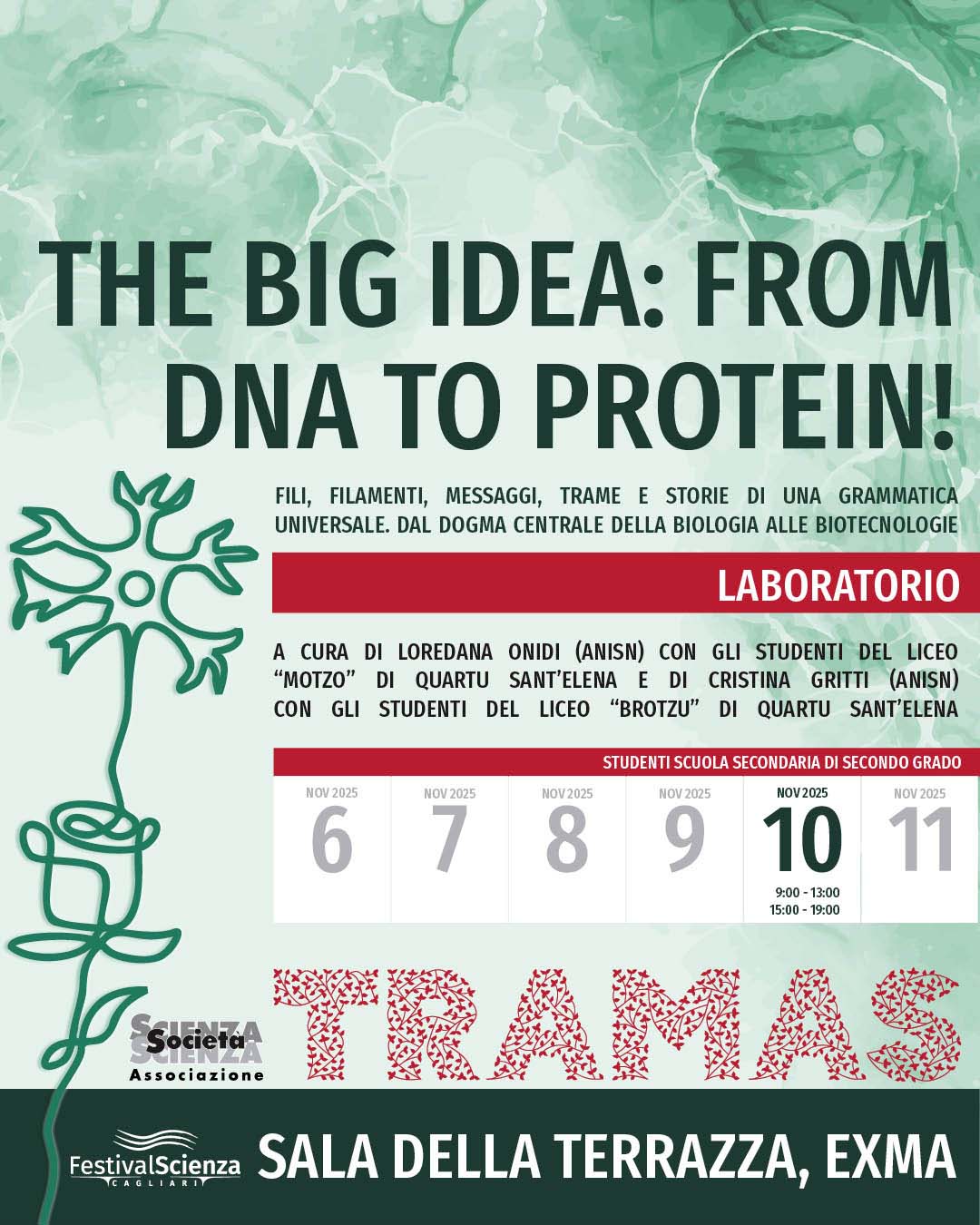
Threads, filaments, messages, plots, and stories of a universal grammar. From the central dogma of biology to biotechnology.
Laboratorio
Scuola secondaria di II grado
EXMA
By: Loredana Onidi (ANISN) with the students of the "Motzo" High School of Quartu Sant'Elena and Cristina Gritti (ANISN) with the students of the "Brotzu" High School of Quartu Sant'Elena
What all living things have in common, yet makes them unique, is the presence within their cells of nucleic acids, DNA and RNA. DNA contains the information needed to build the living organism to which it belongs, a true blueprint for life capable of perpetuating itself over time, across generations, in an astonishingly faithful and reproducible way. The sum of all the DNA molecules in an organism constitutes a vast, complex text, albeit written with only an extremely small number of letters. Genes are instructions written in solid form, using a versatile, simple yet universal language: all living things adopt the same language and the same systems for understanding and decoding the message. The same alphabet as the genetic text, the same grammar. Information takes a journey, identical for all living things: from DNA through RNA to proteins, the finished product. This is the great idea: if the language is common and the journey is the same, we possess an incredibly powerful tool! Today, we have learned to manipulate words, genes; we can induce, move, remove, modify, and combine genetic material to obtain desired products, changing plots and parts of the story. Today, we are beginning to understand more about syntax, that is, how genes interact with each other and with the environment.