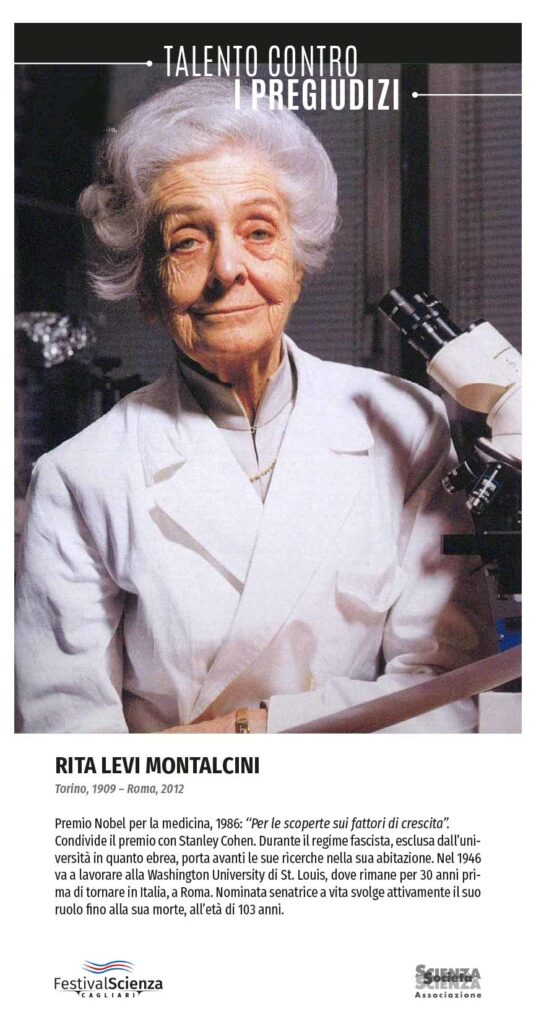
Talent against prejudice
Rita Levi Montalcini
(Turin, 1909 – Rome, 2012)
Historical context
Her life unfolds primarily in Turin, under the rule of the House of Savoy, where Jewish families lived a normal bourgeois life until the arrival of fascism. In 1938, the racial laws were enacted, and Jews were forced to flee or go into hiding. The situation worsened with the outbreak of war, which led many intellectuals to seek refuge in the United States and other countries.
Biography
Rita Levi Montalcini was born in Turin in 1909 to wealthy Jewish parents, an engineer and a painter, who raised their children with a love of culture and intellectual pursuits.
In 1930, she decided to study medicine, overcoming her father’s opposition, who considered medicine an unfeminine career. Rita countered her father, Adamo Levi, and the entire culture of the time, which limited women’s access to education, with her unparalleled intelligence and determination. She graduated from the University of Turin in 1936 with top honors, attending the Giuseppe Levi Institute from her first year, where she met Salvatore Luria and Renato Dulbecco (also future Nobel laureates). After graduation, she began specializing in neurology and psychiatry, unsure whether to pursue a medical profession or research. In 1938, following the racial laws, she was suspended and emigrated to Belgium, where she was a guest at the Institute of Neurology at the University of Brussels to continue her studies and work with Giuseppe Levi, also Jewish and a refugee in Liège. When, on September 12, 1939, news arrived of the outbreak of World War II with the German advance in Poland and the subsequent declaration of war by France and Germany, now certain of an imminent German invasion of Belgium as well, she decided to return to Turin in the hope that Italy would remain neutral. This hope was unfortunately dashed when on June 10 of the following year Mussolini announced Italy’s entry into the war. Once home, to continue her research, since she was forbidden from attending university, she set up a laboratory in her bedroom. Since her research studied the embryonic nervous system, she knew that chicken embryos offered an ideal model, also because they were easy to obtain and develop in a home environment. The winter and spring of 1941 were spent performing experiments that completely absorbed her.
Meanwhile, the campaign against the Jews intensified, and German armies spread across almost all of Europe. In 1943, systematic bombings of northern Italian cities, particularly Turin, began. Rita and her family sought refuge in a house on a hill near Turin, where she continued her research. She cycled from hill to hill, searching for eggs from which to harvest embryos, and every other day, she went to Turin to meet with Levi.
With the fall of fascism, immediately after the armistice of September 8, 1943, German tanks occupied Turin and all of Italy. Hoping for imminent liberation by the Anglo-Americans, the Levi-Montalcini family took refuge in Florence, where they rented a room, concealing the fact that they were Jewish. Here, too, Rita continued her research. In September 1944, the partisans launched the city’s uprising against the Germans, and Florence was thus liberated from the Nazis and Fascists. Rita placed herself at the disposal of the Allied health service and was assigned to provide medical care in a refugee camp. It was a very painful experience that led her to decide not to practice medicine. She said she lacked the detachment that allows a doctor to address the patient’s suffering without emotional involvement that is harmful to both parties. She then resumed her research in neuroembryology, which eventually led her to Washington University in Saint Louis, USA. There, in 1954, she succeeded in isolating a protein that allowed for greater understanding of the process by which cells multiply and assume different functions. In particular, she discovered the protein involved in the development of the nervous system. The discovery of what came to be called growth factors led to understanding medical problems such as deformities, senile dementia, delayed wound healing, and tumors.
For this discovery, she was awarded the Nobel Prize in Medicine in 1986.
Meanwhile, she had returned permanently to Italy to work at the CNR Cell Biology Laboratory, which she founded. Until her retirement from her position as a full professor in the United States (1977), she commuted between Saint Louis and Rome, where she had created a significant research group. In 2001, she was appointed senator for life by President Carlo Azeglio Ciampi “for having glorified the country with outstanding scientific and social achievements.” As a senator, she took strong stances on the social responsibility of scientists, against landmines, against the reckless exploitation of natural resources, and for the right to education and women’s leadership.
Rita Levi Montalcini died on December 30, 2012, at the age of 103.
She always stood by women, those who had to fight prejudice and sexism to enter laboratories, those who saw their discoveries attributed to men, and those who took on the burden of families and research. In 1992, she created a foundation to support African female students with scholarships.