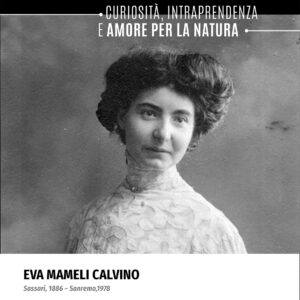
Curiosity, resourcefulness and love for nature
Eva Mameli Calvino
(Sassari, 1886 – Sanremo,1978)
Historical context
Hers was an era of great change and decisive turning points in every field, from science to art: in 1905, Albert Einstein began developing the theory of relativity, and in 1907, Pablo Picasso painted Les Demoiselles d’Avignon, a work that established a new way of looking at reality: the need to show reality not as it appears, but as the mind perceives its appearance. The twentieth century she lived through was also the scene of two world wars.
Biography
In this evolving global scenario, in 1915 Eva Mameli became the first woman in Italy to obtain a teaching qualification in botany.
Eva Mameli, born Giuliana Luigia Evelina Mameli, was born in Sassari on February 12, 1886, to Giovanni Battista, a Carabinieri colonel, and Maddalena Cubeddu. The family later moved to Cagliari, where Eva attended high school and then university, graduating in mathematics in 1905 at just 19 years old. She later moved to Pavia, graduated in natural sciences, and, having become an assistant in botany, was able to devote herself to studies in plant physiology and pathology, which in 1915 allowed her to become the first woman in Italy to earn a teaching qualification in botany at just 29 years old. When war broke out, she enlisted as a Red Cross nurse and was awarded two medals for her admirable work. After the war, she continued her research and received various academic awards, including, in 1919, a prize for natural sciences from the Accademia Nazionale dei Lincei. Her fame reached Cuba, where Mario Calvino, an eminent agronomist from Sanremo, directed an experimental agricultural station. Constantly in touch with the Italian Botanical Society, he was familiar with Eva Mameli’s work, and when he needed to add a botanist with expertise in genetics to the working group to conduct research on tropical plants, he chose Eva. He came to Italy to meet her, the two fell in love, married, and immediately began new research in Cuba. Three years later, the couple had their first child, Italo Giovanni, who would become one of the greatest Italian writers of the 20th century.
In addition to their scientific endeavors, on the Caribbean island, which was experiencing a severe economic crisis, the couple also launched social initiatives and worked hard to improve the living conditions of campesinos and their families, creating vocational schools, publishing magazines for farmers, and also working for women’s emancipation. In 1925, they returned to Italy, where her husband was appointed director of the Sanremo Experimental Floriculture Station, where they settled, bringing several species of plants to Italy for the first time, including palms, grapefruits, and kiwis.
The following year, Eva Mameli won the competition for the chair of botany in Cagliari, which she held from 1926 to 1928, along with the direction of the botanical garden: two prestigious academic positions that no woman had previously held. The Cagliari Botanical Garden owes its rebirth to her after a long period of neglect since the Great War.
Thanks to Eva’s work, the garden of Villa Meridiana, the Calvino family’s home in Sanremo, is transformed into a lush place for botanical research and, at the same time, a safe haven for birds.
These were the years of his work for environmental protection and raising awareness and information on the defense and enhancement of the natural environment, especially in schools, spreading what we would today call the culture of urban greenery for the purpose of increasing and protecting biodiversity.
During the period of the Republic of Salò, the Calvino family hosted the most authoritative anti-fascists of Sanremo in their home, where the plan to free some political prisoners held by the Germans was hatched.
I figli Italo e Floriano, renitenti alla leva dell’esercito di Salò, parteciparono alla Resistenza con i nomi di “Partigiano Santiago” e “Partigiano Floriano”. La reazione fu immediata e spietata: Mario ed Eva, arrestati perché fornissero informazioni sul nascondiglio dei figli, subirono entrambi false fucilazioni. Il marito, sconvolto dalla notizia della falsa fucilazione della moglie, ne restò segnato per il resto della vita.
Nel 1951, dopo la morte del marito, Eva assunse la direzione della Stazione di Floricoltura sanremese. La Liguria le deve lo sviluppo della florovivaistica, in una regione allora povera e in cui si coltivavano solo agrumi, vite e olivo. E si deve ai suoi studi innovativi se Sanremo è oggi nota in tutto il mondo come la città dei fiori.
Fu anche una pioniera in termini ambientalistici con la sua personale battaglia per la protezione degli uccelli e una grande divulgatrice. Assieme al marito fondò l’Associazione Italiana amici dei fiori e la rivista Il Giardino Fiorito e collaborò a varie altre opere di divulgazione.
Morì a Sanremo nel 1978, all’età di 92 anni.