Despite it all
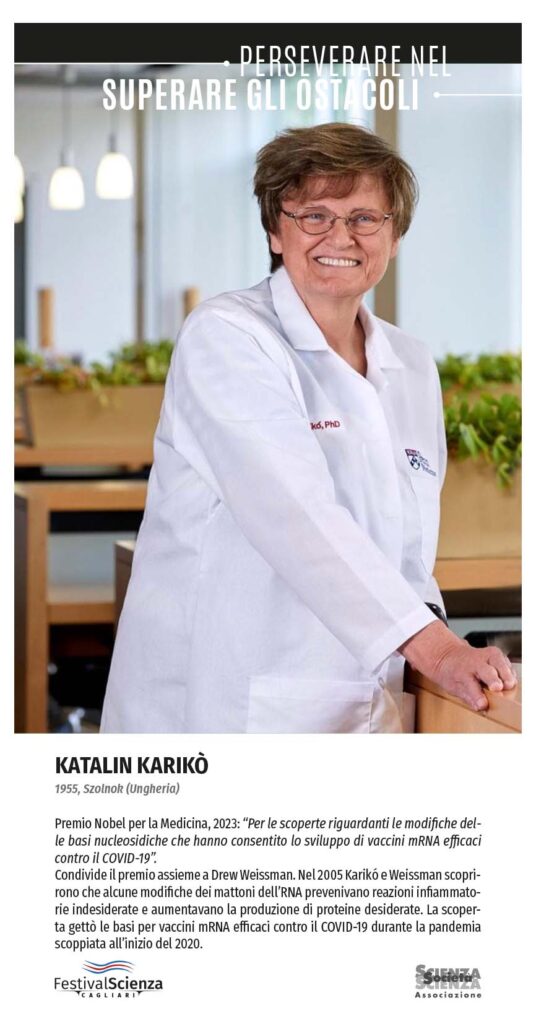
Katalin Karikò
(1955, Szolnok, Hungary)
Historical context
Biography
She was born in 1955 in Szolnok to a very modest family, the daughter of a butcher, in post-war Soviet Hungary, who lived in a mud-walled house with no running water and an outside toilet. Her father suffered repression following the Budapest rebellion, later bloodily suppressed by Soviet tanks. He was arrested and lost his job.
Despite everything, thanks to her curiosity and tenacity in her studies, with the support of her family, Katalin managed to earn her doctorate at the University of Szeged, a university that, despite being under the watchful eye of the Soviet police, was welcoming and well-organized.
She says of herself that she succeeded in her studies thanks to “the will to work intensely and methodically, without ever stopping” (1). During her doctorate, she began working at the Biological Research Center, working on RNA in search of an antiviral drug. But the results were inconclusive, and the pharmaceutical company that was funding the project withdrew, leaving Katalin to look for a new job.
In 1985, she moved to the United States with her husband and daughter, with only $1,200 sewn into her daughter’s teddy bear (Hungarians were not allowed to take more than $50 out of their country at the time). Katalin continued her postdoctoral studies at the Department of Biochemistry at Temple University in Philadelphia, specializing in RNA technology. In her autobiography, she recounts the early stages of her research, the abuse she endured from the head of the lab where she worked, and her desperate search for a new lab where she could continue her studies. She accepted fellowships and research grants, and adapted to commuting. Finally, she began working at the University of Pennsylvania School of Medicine. There, she discovered the importance of working on mRNA.
In 1998, she began collaborating with Drew Weissman, an immunologist trained in Anthony Fauci’s laboratory at the National Institutes of Health. Weissman dreamed of developing an HIV vaccine and, after several failures with DNA, decided to experiment with RNA, thanks to Katalin’s help. Their teamwork proved constructive and effective, and in 2004 they succeeded in producing a modified mRNA that, when introduced into a cell, had the ability to produce proteins capable of fighting pathogens. Initially, their work, published in a specialized journal, did not seem to interest the scientific and economic world. The same misunderstanding occurred at Penn University. Katalin then decided to leave and was hired by BioNTech, in Mainz, Germany, a pharmaceutical company researching immunotherapy drugs in the fight against cancer.
At the end of 2019, the pandemic broke out, and BioNTech reached an agreement with Pfizer for the production of modified mRNA vaccines. We know the rest of the story.
Throughout her scientific journey, Katalin has always had her husband by her side: “We met while we were studying, and he supported me every step of the way. He moved with me to a foreign country without resources, with our two-year-old daughter. He did all this to allow me to continue my research. He also supported me when we moved to Germany eight years ago to continue clinical studies.”
With the mRNA vaccine, Katalin became famous, receiving awards from around the world and honorary degrees. In 2022, she received an honorary degree in Medicine from the Humanitas University of Milan. Her future projects involve cancer treatment. The hope is to inject mRNA into the tumor that prompts tumor cells to release cytokines, thus attracting the immune system’s attention. This way, immune cells can locate and destroy tumor cells, even when the cancer metastasizes. Hoping that the project will soon be realized, Katalin Karikó was celebrated with the Nobel Prize awarded to her in 2023, recognizing her extraordinary determination, genius and perseverance.