To put an end to the recurring and bloody conflicts that culminated in World War II, European politicians began the process of building what we now know as the European Union. On March 19, 1958, the first meeting of the European Parliamentary Assembly was held in Strasbourg, which, on March 30, 1962, was renamed the European Parliament. However, this was also the period of the Cold War, which would divide the continent for over 40 years. 1958 was a turning point for France as well, as on October 4, 1958, the current French Constitution was approved, giving rise to the current French system of government, known as the Fifth Republic, characterized by a semi-presidential form of government.
Biography
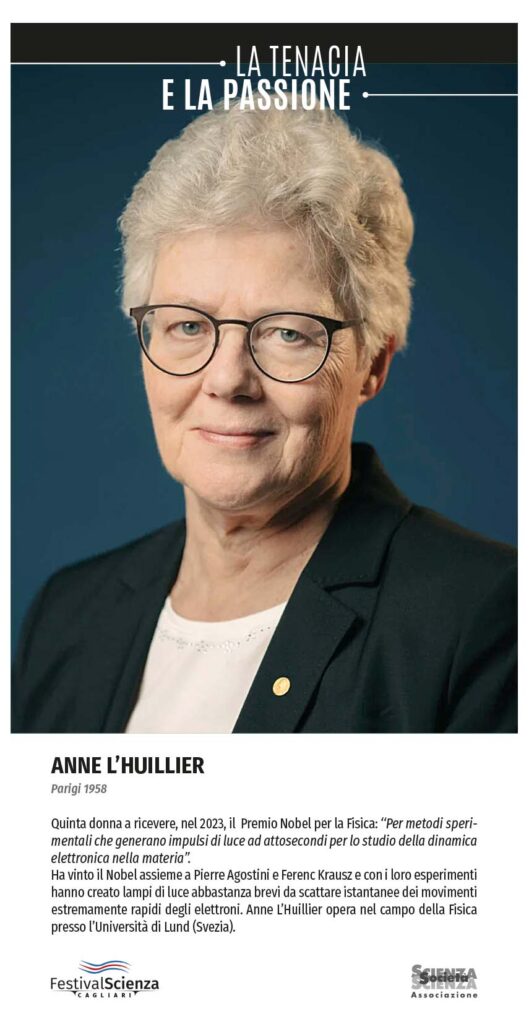
Born in Paris in 1958, the daughter of a computer engineer and a schoolteacher who left her job to care for her three children and her failing health. Strongly inspired by her father and confident in the advances in science and medicine that had helped her mother survive despite the severity of her illness, after her baccalauréat, it was natural for her to continue her scientific studies at the Ecole Normale Supérieure in Fontenay-aux-Roses, initially with the goal of becoming a teacher. Her subsequent studies led her to fall in love with quantum mechanics and atomic physics, and she began her research in this field under the guidance of prestigious teachers, some of whom went on to win the Nobel Prize in Physics. In the summer of 1987, she and her team conducted an experiment that had a profound impact on her scientific career. Studying the emission of photons from a gas target irradiated by an intense laser field, he felt the need to further his theoretical and experimental research on the action of lasers and their potential. In 1997, she was appointed professor of atomic physics at Lund University thanks to a Swedish government initiative to fund professorships for women to promote gender equality. She was appointed to the Nobel Committee in Physics, a position she held from 2007 to 2016, while continuing her research on lasers and the increased control of pulses at ever-faster frequencies. For these studies she was awarded the Nobel Prize, the citation of which reads “for experimental methods generating attosecond light pulses for the study of the dynamics of electrons in matter.” She received the call from Stockholm informing her of the award while she was lecturing in the classroom to her third-year engineering physics students. She received several scientific awards for her research and was elected a foreign member of many academies, most notably the French Academy of Sciences, even though she had left France thirty years earlier.