Medicine as a utopia: relationship, liberation, vision. [1]
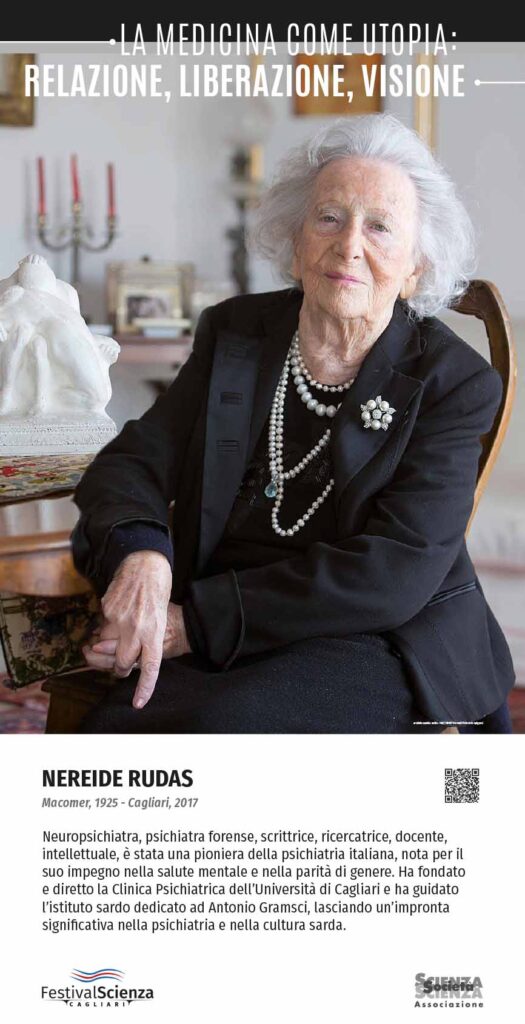
Nereide Rudas
(Macomer, 1925-Cagliari, 2017)
Historical context
In Cagliari, until 1858, patients suffering from mental illnesses were housed in two rooms of the ancient Sant’Antonio Abate Hospital, dating back to the 14th-15th centuries and located within a convent complex of the Order of the Knights of Saint Anthony of Vienne. That same year, the new San Giovanni di Dio Civil Hospital was inaugurated, which included a section dedicated to psychiatric patients. In 1859, the same hospital established a psychiatric clinic, marking a significant turning point both in the treatment of mental illnesses and in the history of psychiatry on the island.
At the same time, teaching in the Clinic of Mental Illnesses also spread to the University of Cagliari, following the Italian national trend.
In 1896, the Province of Cagliari leased Villa Clara and a nearby building to house non-dangerous psychiatric patients. In 1900, it was decided to build a permanent asylum on the same site, which took the name of the villa. From 1907, the new center began operating at full capacity: the restored villa became the director’s residence, and the rustic buildings were used as stables, warehouses, and accommodations for the agricultural colony, where patients performed work for therapy and to support the facility. The colony included a vineyard, a vegetable garden, livestock, and, from 1911, a tree nursery with various species. With the Basaglia Law of 1978 and the closure of the asylum, the custodial-centered model of psychiatric care also came to an end in Cagliari.
Biography
She was a pioneering figure in Italian psychiatry, distinguishing herself as the first woman to hold prominent positions in both academic and professional fields. Her career was distinguished by her commitment to promoting mental health and gender equality.
Born in 1925, this year marks the centenary of her birth. She was named after her maternal grandmother, Nereide Tibi, originally from Macomer and married to Gustavo Salmon, a Jewish entrepreneur who moved to Sardinia. She spent her childhood with her maternal grandparents, having lost her father at a young age. She graduated in Medicine and specialized in Neurology and Psychiatry, fields characterized by a strong male predominance at the time. The difficulties she encountered due to gender prejudice did not hinder the professional path she had chosen.
She was the first woman to found and direct a psychiatric clinic in Italy and to be appointed to the Chair of Psychiatry at the University of Cagliari in 1978. Founder of the Italian Society of Forensic Psychiatry, she also strengthened the Italian Society of Psychiatry, becoming its Vice President in the 1980s, remaining its only woman for years. She also represented Italy on international scientific missions.
She has published over 450 scientific articles and written works exploring Sardinian identity, such as “The Coral Island,” and femicide, coining the term “muliericidio.”
Politically and socially engaged, she has dedicated her life to the fight against gender violence, emphasizing the importance of a language that represents women and their experiences.
She had a lasting impact on the training of new generations of psychiatrists and directed important psychiatric institutes.
She has received numerous awards for his work, including the Gold Medal from the President of the Republic for his book on Sardinian identity and the Honor of the American Academy of Psychiatry and the Law.
She died on January 19, 2017.
Her indomitable spirit and strong, determined character, perhaps influenced by the modern and stimulating environment she lived in with her grandfather Salmon, a patron and art lover, allowed her to overcome the obstacles inherent in her status as a woman, challenging beliefs and prejudices and succeeding in a world, the healthcare sector, dominated by men.
She was an exceptional psychiatrist who treated each case with individual attention, evaluating the individual and their needs. She was also a great scholar of the mechanisms of society. In 1970, she was appointed to the Parliamentary Commission of Inquiry into the Phenomena of Crime in Sardinia. Particularly important were her insights into the gender inequality, muliericide (a neologism she preferred to feminicide), and the causes of violence and depression resulting from job loss and the economic crisis.
A woman of vast culture, she passionately studied Antonio Gramsci and was among the founders of the Institute named after him, of which she served as president for over twenty years. During the last ten years of her life, she also served as president of the literary prize dedicated to Francesco Alziator, an intellectual and writer from Cagliari.
[1] The phrase used by Nereide Rudas is:
Medicine as a total, almost utopian form of existence: a relationship with others, a liberating modality, a vision of the world.