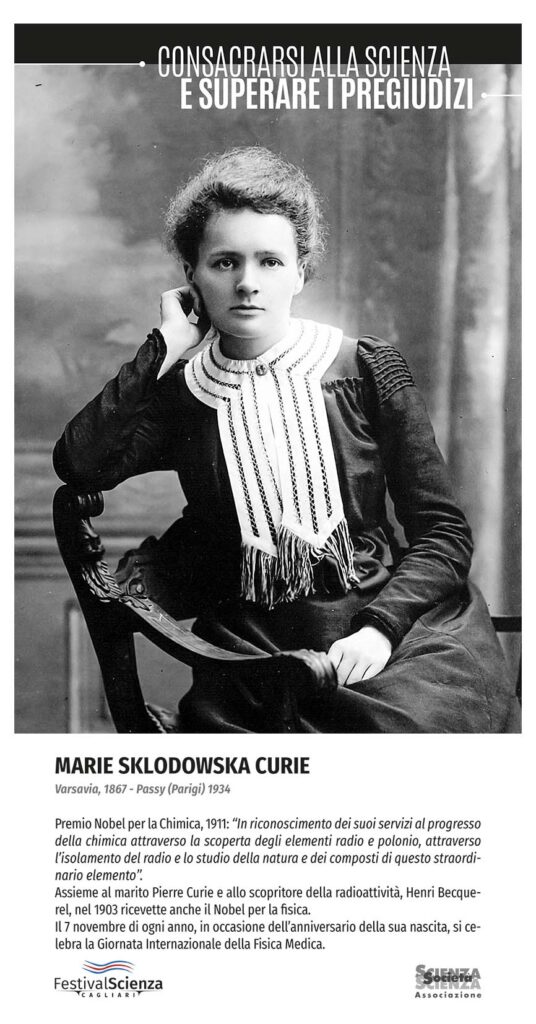
Devoting oneself to science and overcoming prejudices
Marie Sklodowska Curie
Warsaw, 1867 - Passy (Paris) 1934
Historical context
Biography
Marya Skłodowska, as she was named, was born in Warsaw, Poland, a poor country oppressed by the domination of Tsarist Russia. She arrived in Paris in 1891 to study physics at the Sorbonne, considered the most prestigious university in the world at the time. To get there, she had made a very long and arduous journey in a fourth-class carriage. She lived in a humble attic in the Latin Quarter, a tiny room illuminated by a dormer in the sloping roof. It had no heat, no lighting, and no running water. She graduated in physics and mathematics. Immediately after graduation, she met Pierre Curie, whom she married on July 26, 1895. Marie, who had already changed her name as soon as she breathed the air of Paris, took her husband’s surname because she felt hers was too difficult for Parisians to pronounce. Shortly after the marriage, her first daughter, Irène, was born, but she wanted to continue her studies and earn her doctorate. In those years, two major discoveries had been made: at the end of 1895, Röntgen had discovered X-rays, and a few months later, Becquerel discovered the rays spontaneously emitted by uranium salts, rays capable of impressing a photographic plate. Marie decided she would study uranium rays. After studying their characteristic quantities, she sought to determine whether uranium was the only chemical element that produced such radiation. She found that only minerals containing uranium or thorium emitted them. She also discovered that certain minerals, such as pitchblende, emitted much greater quantities of rays than one would expect for the amount of uranium or thorium they contained. She realized that these minerals must contain an unknown substance more highly emissive than uranium and thorium.
After this astonishing discovery, she decided to dedicate herself, together with her husband Pierre, to the search for the new substance. In 1902, almost four years after the probable existence of radium was announced, Marie managed to prepare a decigram of pure radium chloride, performing backbreaking work in a dilapidated hangar, exposed to rain and wind, the only space available to them. The following year, Marie received her doctorate, and in December of that year, Pierre, Marie, and Becquerel were awarded the Nobel Prize in Physics for their discovery and research on radioactivity.
After the birth of her second daughter, Eve, in 1906, her husband Pierre was killed in a car accident. She was left alone with two small children to raise and fell into a deep depression, from which she recovered, returning to her work with determination. She applied to the Académie des Sciences, becoming the first woman to enter. As soon as Le Figaro reported the news, anti-Semitic sentiments, prejudice against women and foreigners, sparked a vicious press campaign against her, ultimately resulting in her exclusion. Disappointment and her latent depression had led her to seek comfort in a friend and colleague of Pierre, Paul Langevin. This unleashed the fierce petty-bourgeois respectability of the French against her. She endured a new cruel press campaign as well as threats against her and her daughters. Almost simultaneously, she received the telegram announcing her second Nobel Prize, this time in chemistry, for her studies on radioactivity and for the discovery of radium and its beneficial uses. For her, it was the pinnacle of science, but her life as a woman was shattered. Upon returning from Stockholm, she had to be hospitalized, and it took a year for her to recover.
But she recovered, and given the importance of her studies on radioactivity, she set about building a research laboratory at the Sorbonne. In July 1914, the Radium Institute was ready to welcome its researchers, but on August 1 of that year, the First World War broke out. Marie placed herself at the disposal of the army medical service. She installed X-ray equipment on small vehicles with which she drove to the battlefields of the Marne, taking X-rays of the wounded on the spot to speed up operations. Out of loyalty to France, which had welcomed her, she completely forgot the indignities she had suffered. After the war, she continued her research at the Radiological Institute. To raise funds for the Institute and obtain the now very expensive radium needed for her research, she traveled to the United States, where she was welcomed by thousands of people and received a gram of radium from the President of the United States. From then on, she became a legend.
Unfortunately, the long years spent in contact with radioactive substances left her with a severe form of anemia, now known as leukemia, which led to her death in July 1934, during a long hospital stay in the Passy sanatorium.