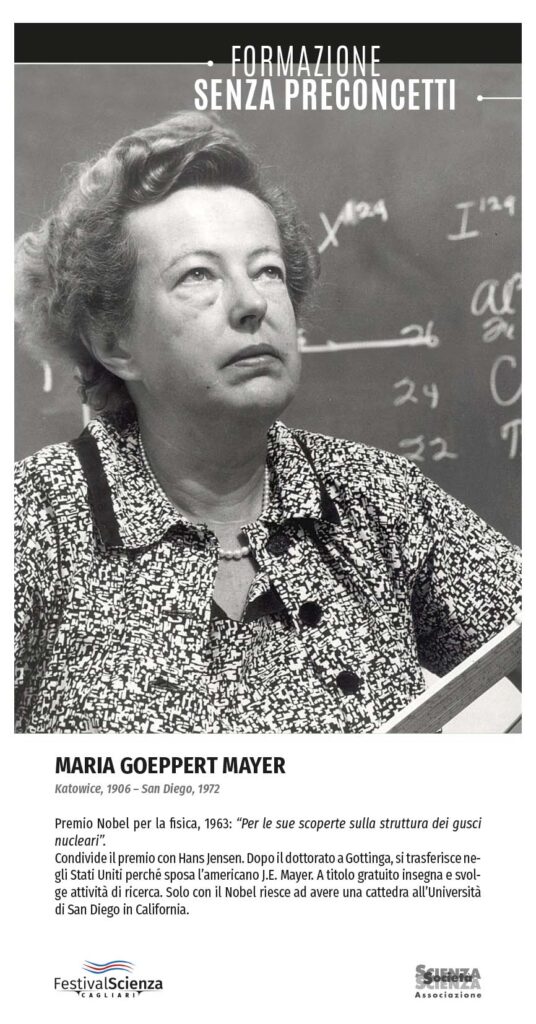
Training without preconceptions
Maria Goeppert Mayer
(Katowice, 1906 – San Diego, 1972)
Historical context
Biography
Having arrived at university after attending the Frauenstudium, a private school run by suffragettes that aimed to prepare girls for university (1), she studied at Göttingen with Max Born in the late 1920s, when quantum mechanics was first emerging, and became an expert in quantum chemistry. After receiving her doctorate, she married Joseph Mayer, an American chemist visiting Göttingen. When Mayer was offered a position at Johns Hopkins University in Baltimore, the couple moved to the United States. It was the Depression era, and no university would think of hiring a woman, let alone the wife of a professor. However, despite being unpaid, she continued to do research, publishing an important paper on double beta decay and collaborating with Karl Herzfeld on several papers in the field of chemical physics.
In the early 1940s, as part of the Manhattan Project, Goeppert Mayer, despite not having a formal position, worked at Columbia University with Harold Urey on the separation of U-235 from natural uranium. In 1946, Joseph Mayer was appointed professor in the Chemistry Department at the University of Chicago. Once again, Maria followed her husband without any academic position, but was able to work as a volunteer, unpaid, Associate Professor at the newly established Institute for Nuclear Studies. She then taught courses in the Physics Department and supervised several graduate students on a voluntary basis. And it was thanks to an offer from her first graduate student, Robert G. Sachs, that she landed a paid part-time position as a senior physicist at Argonne National Laboratory (now Fermilab). There, she expanded her expertise in the complex mathematics of nuclear physics and studied nuclear properties through the periodic table. She knew very little about nuclear physics, and it took her some time to find her way in this, for her, new field. But in the atmosphere of Chicago, it was quite easy to learn nuclear physics. She owed much to numerous discussions with various scientists, and, in particular, with Enrico Fermi, who was always patient and available. From here began the research that led to her Nobel Prize. Among the problems she addressed, in connection with the origin of chemical elements, she noted that the abundance of elements, their stability, as well as other characteristics, could be associated with particular numbers of protons and neutrons (2, 8, 20, 28, 50, 82, 126), called magic numbers, and she came to propose a model of a nucleus with stable layers similar to the atomic model. While writing the paper, she came across an article that proposed a substantially similar solution. Maria did not then know Jensen, a physicist from Heidelberg, one of the authors, but in 1951 they began a fruitful collaboration and friendship, culminating in the publication of their book Elementary Theory of Nuclear Shell Structure (1955). For their contributions to the subject, they jointly won the 1963 Nobel Prize. She was the first woman to win a Nobel Prize in theoretical physics, and second overall after Marie Curie.
Meanwhile, in 1960, at the age of fifty-four and after at least thirty years of passionate dedication and undeniable talent to scientific research, she had obtained a position as a full professor of physics at the University of California, San Diego. Finally, her first position with a regular salary, which gratified her greatly and encouraged the formation of an interdisciplinary group of scientists with whom she worked until her death.
Maria Goeppert-Mayer quietly fought the injustices of the male-dominated scientific field. When the Swedish Academy announced the Nobel Prize, a local newspaper ran the headline: “San Diego Mother Wins Nobel Prize.” A reductive comment that, unfortunately, is still emphasized when discussing women who succeed.
(1) She took the abitur, the university entrance exam, at 17, a year early, along with three or four girls from her school and 30 boys. All the girls passed. Only one of the boys passed.