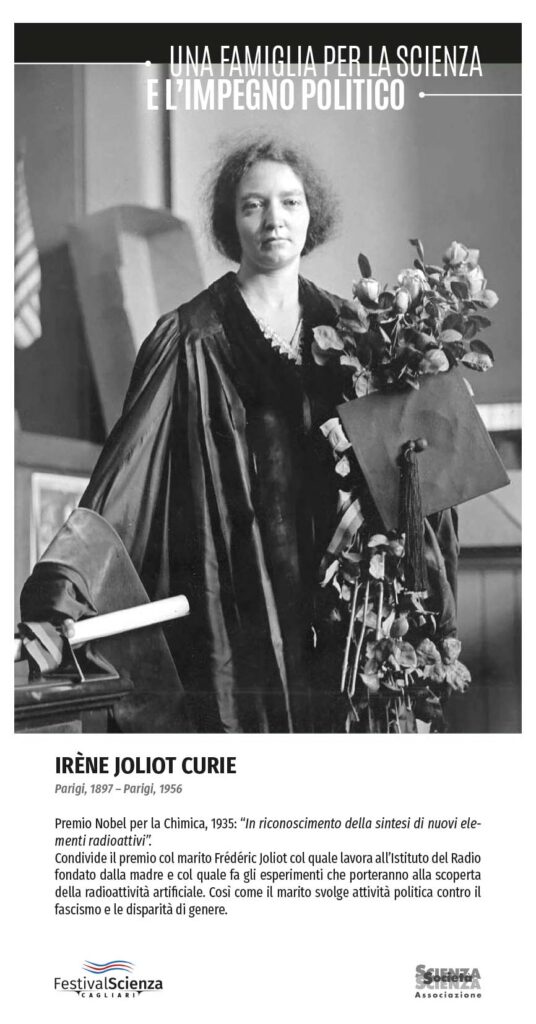
A family for science and political commitment
Irène Joliot Curie
(Paris, 1897 – Paris, 1956)
Historical context
On May 10, 1940, the Germans, violating Belgian neutrality, broke through the French front. France was unable to organize a counteroffensive. On May 15, the Germans entered Paris. They faced a defeatist front that united a cultural and political right, openly pro-Nazi and pro-Fascist, with the left of the powerful Communist Party, which, faithful to the agreement between Hitler and Stalin, proclaimed the need for peace at all costs. All this was shrouded in widespread corruption.
Biography
When her father, Pierre Curie, died in 1906, she was nine years old and her sister Eve was only two. As an adult, she said she owed most of all to her paternal grandfather, Eugène Curie, her “incomparable friend,” for raising a happy and curious child. She also owed it to him and to the lessons her mother, Marie Curie, taught to the children of colleagues at the Sorbonne, in a sort of alternative school to traditional education, that her interest in science blossomed at a very early age. During those lessons, she was fortunate to have exceptional teachers and a teaching method based on scientific experiments conducted under their guidance.
It was therefore natural for her to continue her studies in the footsteps of her mother. During the war, while continuing her studies at university, she and her mother completed several missions in the army’s radiology services.
After graduating, she entered the Radium Institute founded by her mother, where she furthered her studies on the radioactivity of polonium (discovered by her mother). At the Institute, she met her husband, Frédéric Joliot, with whom she continued her research on radioactivity. Frédéric was Marie Curie’s personal assistant at the Institute.
In carrying out various experiments, Irène and Frédéric discovered that, by bombarding other light elements such as lithium, beryllium, and boron with alpha particles emitted by a sample of polonium, they emitted weak radiation. Following these observations, James Chadwick, in 1932, discovered that the radiation emitted consisted of electrically neutral particles with a mass approximately equal to that of a proton: this was the discovery of the neutron. Somewhat disappointed at having narrowly missed discovering this particle, Irène and Frédéric continued their research and discovered that, using a polonium source and bombarding boron, aluminum, and magnesium with alpha particles, they were able to produce new elements that did not exist in nature. These elements then spontaneously decomposed over a more or less long period, emitting positive or negative electrons. It was 1934; artificial radioactivity had been discovered. Marie Curie, now ill and frail, was able to witness their discovery, and Irène will forever remember the expression of immense joy she felt when, using a Geiger counter, she listened to the numerous “tocks” with which the counter detected the activity of their first artificial element. A few months later, Marie Curie died of leukemia in the Passy sanatorium.
The following year, 1935, Irène and Frédéric were awarded the Nobel Prize in Chemistry. That same year, the Nobel Prize in Physics was awarded to the discoverer of the neutron.
The discovery of artificial radioactivity was very important, especially for its applications in biology and medicine.
Meanwhile, while continuing their research, Irène and Frédéric indulged their political sympathies. In the 1930s, Irène took part in the anti-fascist movement, supporting the Spanish Republicans. In 1936, she briefly accepted the post of Undersecretary of State for Scientific Research in the Front Populaire government (a coalition of left-wing political parties that governed between 1936 and 1938), largely to emphasize the role of women in society. Frédéric also had a keen interest in politics. He had joined the French Communist Party and, like her, supported the Spanish Republicans against Franco.
In June 1940, Paris was occupied by Hitler’s Nazis. Irène, now ill (she had contracted tuberculosis), secretly left Paris with her two children in 1944 and took refuge in Switzerland, while Frédéric remained in Paris, continuing his activities as a member of the resistance to help liberate the country from the Nazis.
After the war, as a progressive and deeply opposed to the atomic bomb, Irène served on numerous committees for peace and gender equality. Like her mother, she ran three times, unsuccessfully, for the Académie des Sciences to seek recognition of women’s equality in science.
Irène Curie dedicated her final years to the creation of a research center capable of housing the large accelerators essential for nuclear research. His program is the origin of the Campus d’Orsay at the University of Paris-Sud. The Institute of Nuclear Physics was inaugurated after his death on March 17, 1956, from a serious form of leukemia.