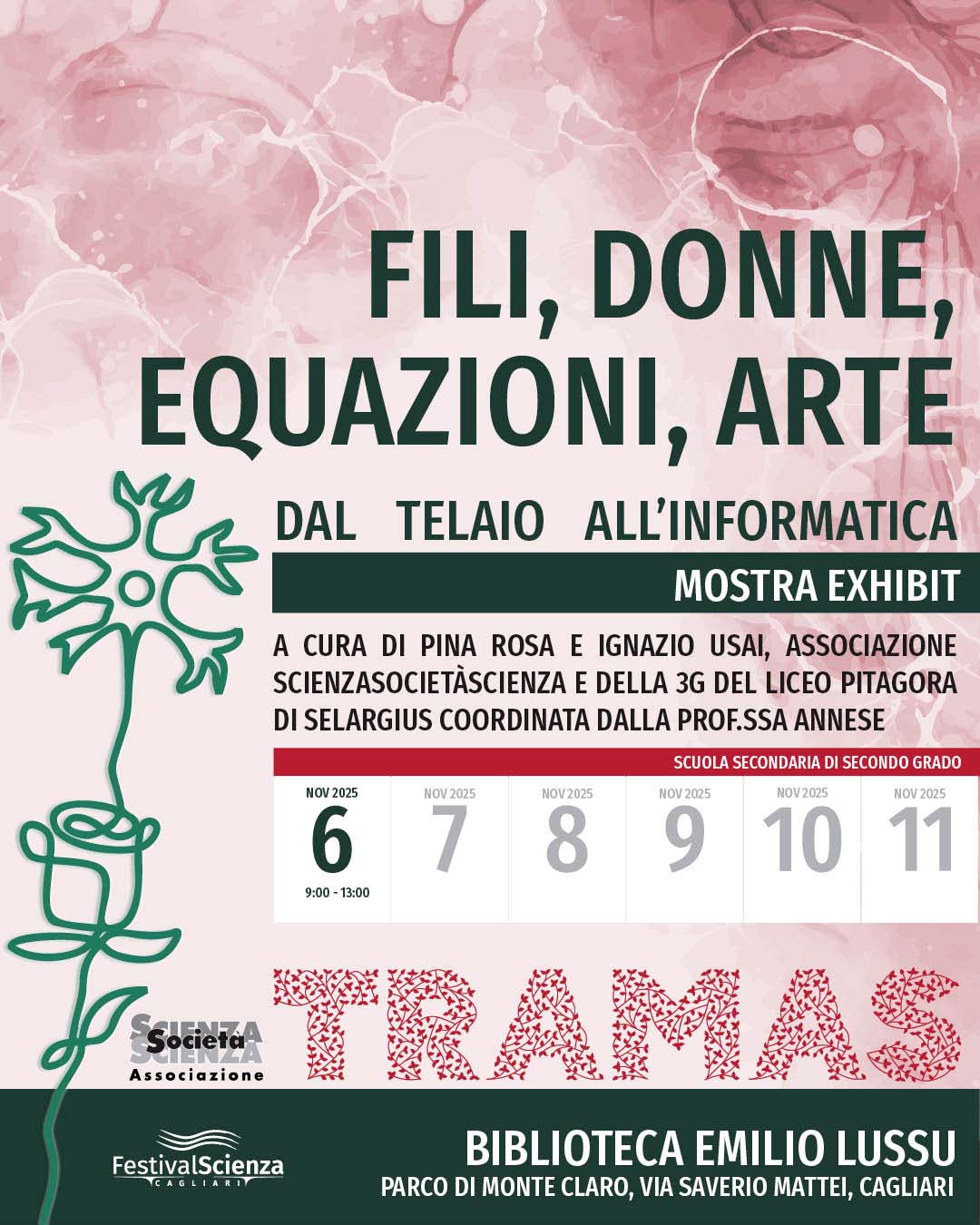
By: Pina Rosa and Ignazio Usai (ScienceSocietyScience Association) and the 3G of the Pitagora High School of Selargius coordinated by Prof. Annese
What’s hidden between the weaves of a fabric? What does mathematics have to do with it?
Mathematics, with its representation techniques, has been present since the very beginning of a fabric’s life, since its conception. The basis of every fabric’s construction is the weave, that is, the way the warp and weft threads intertwine. Different weaves are obtained by raising some warp threads and leaving the others lowered, inserting the weft into the space thus created. Thanks to varying combinations, several thousand weaves exist. To design a fabric, the weave is graphically represented on graph paper: if you want the warp to pass over the weft, you color the corresponding square, while if you want the warp to pass under the weft, you leave it blank. This is equivalent to using only zeros and ones. In the most common fabric, plain weave, the warp thread passes alternately over and under the weft: in its matrix, which is that of a simple weave, there are zeros and ones arranged in a checkerboard pattern.
The invention of the first computers was inspired by the punched card mechanism of the Jacquard loom.