The word geometry evokes triangles and circles, areas, perimeters, and above all, the Pythagorean Theorem. For many, geometry is an abstract world, carved in stone over two millennia ago by Greek mathematicians like Euclid and Archimedes. Before the Greeks arrived on the scene, however, it had been used for millennia by various, diverse civilizations. And after the Greeks, it evolved enormously. The great classical problems, squaring the circle and Euclid’s fifth postulate, literally obsessed mathematicians for two millennia before being answered. And in the search for answers to these classical questions, geometry changed, and new areas of mathematics were born. We moved from “Geometry,” the one and only true one, of which we are certain thanks to logic, to a much more varied panorama, vibrant with different geometries. In the nineteenth century, the certainties of mathematics crumbled, and its foundations were rewritten. Klein provided a new description of what geometry is, and Hilbert completely overturned the concept of mathematical truth. These are mathematical revolutions that would revolutionize physics at the beginning of the twentieth century, paving the way for Einstein’s relativity and quantum mechanics. The history of geometry, its identity crisis, its being one, none, and a hundred thousand, is closely intertwined with the history of mathematics, physics, science, and ultimately with the history of the culture of which we are all a part. This essay offers us a glimpse, capable of also taking us deeper, into the architecture of a thought that increasingly better describes the Universe around us.
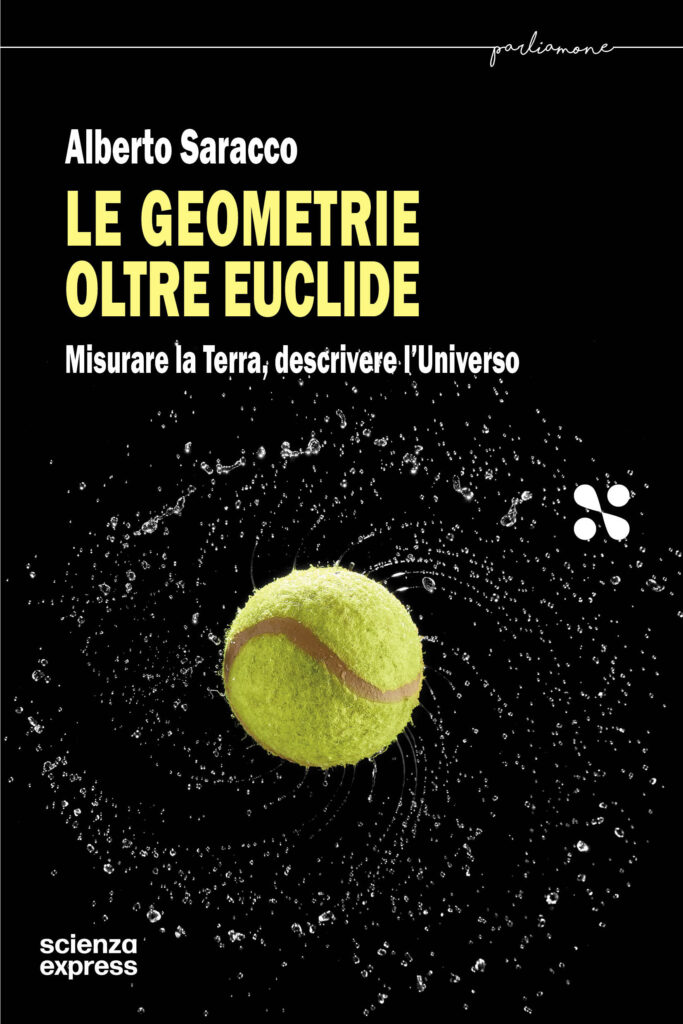
Alberto Saracco
Mathematician. Graduated from the University of Pisa, and completed postgraduate studies at the Scuola Normale Superiore. Associate Professor of Geometry at the University of Parma, he has been involved in mathematics education for 20 years. He collaborates with MaddMaths, Scienza Express, UMI, Master CoSe uniPR, and Nuova Lettera Matematica.
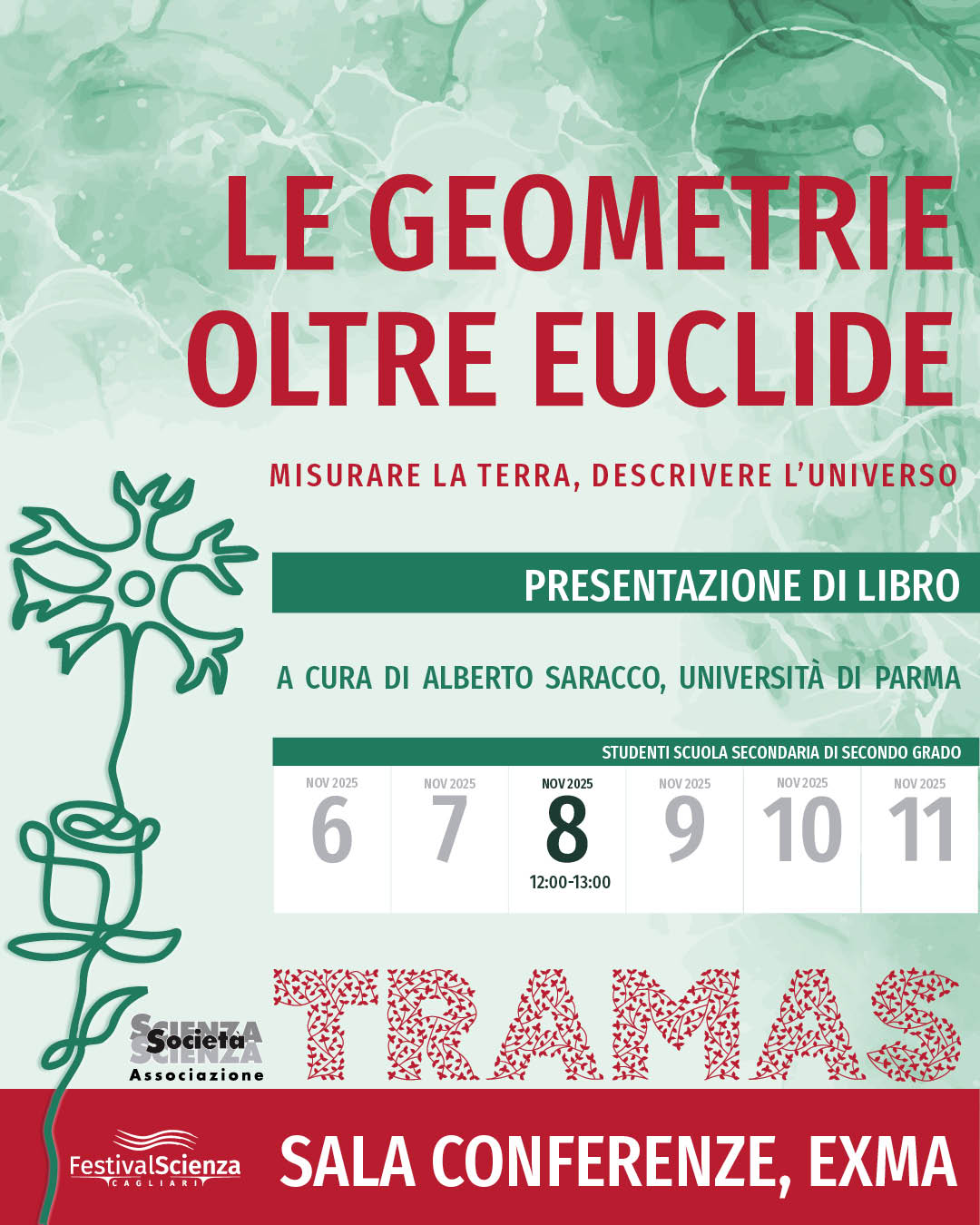
Geometries beyond Euclid
Measuring the Earth, describing the Universe
Scienza Express
The word geometry evokes triangles and circles, areas, perimeters, and above all, the Pythagorean Theorem. For many, geometry is an abstract world, carved in stone over two millennia ago by Greek mathematicians like Euclid and Archimedes.
Before the Greeks arrived on the scene, however, it had been used for millennia by various, diverse civilizations. And after the Greeks, it evolved enormously. The great classical problems, squaring the circle, and Euclid’s fifth postulate literally obsessed mathematicians for two millennia before they found an answer.